Showing posts with label ELA. Show all posts

Phonics Poetry for Grades K-2!

Do your young learners have poetry journals?! Mine do and we love them. 

The main question I have been asked in the past is what I put inside my journals and I created a resource to help answer that question. Most of the poems in our poetry journals are phonics poems, but I also am sure to include plenty of seasonal and holiday poems throughout the year.

I always had trouble finding poems that were appropriate for my first graders to decode on their own throughout the year, so I used to make up a few of my own. I decided this past year to make lots more, type them up, add some clipart and borders and voila! Here is my newest unit, Phonics Poetry for Grade K-2!

If you want to see how I set up my poetry journals in the class, click the picture below to read my previous post on Blog Hoppin' AND snag one of the poems for free!

Inside my phonics poetry pack, there are 27 different phonics poems that focus on common word families and phonemes taught in Kinder, 1st grade, and the beginning of 2nd grade. Each word family or phoneme has a short, simple poem written by me, a practice page for students to record their words and sort real vs. nonsense words, and there is also a visualization sheet. 


Here is a close up of each:
Poem: the above poem focuses on long vowel e, spelled /ee/. The set up of my poems are very similar so students can get used to them. Students read the poem many different times and ways and then glue it into their poetry journal and color in the picture.

Visualization Page: I find that poetry is the perfect time to teach visualization! Sometimes instead of the full-sized sheets, I will substitute the poem for that week with a visualization sheet. We still read the poem numerous ways and identify the words with the word family or phoneme we are learning that week. Instead of simply coloring in the clip art on the page, I have my students draw what the poem is about! It is a great way for me to see who can actually decode the poem and understand it.

Practice page: This is the page we complete after we read and illustrate our poems. It allows students to record some of the words they found in the poem as well as decode real and nonsense words with that word family/phoneme.

I also included a few sheets on how and when I use these sheets in my classroom:
My kids really love collecting these poems in their journal throughout the year and I allow plenty of time for students to read through their poetry journal. It also makes for quite the keepsake when they leave my classroom in June!

To see more, head over to view my Phonics Poetry unit on TPT and download the preview!
It is also on SALE through tomorrow night!

PS - as the year progresses I plan to add a few more phonemes, word families, and consonant blends to this unit. Feel free to let me know if there are ones you would like added! I just ask that you please be patient with me as THIS is what's going on in my life right about now:
...now THREE more days...
7

Starting Writer's Workshop in First Grade!

This past week we began our writer's workshop lessons!

I use my writer's workshop units throughout the year, but before we dive into small moments we talk about what Writer's Workshop looks like in our first grade classroom.

This poster is hanging in our classroom and we go through each of these bullet points throughout the first week!
-Lights off: My classroom is lucky enough to have tons of windows and we are able to turn down all the lights and still have plenty of natural sunlight to write with!

-Music on: This one little CD has allowed me to curb talking during writer's workshop more than anything I have tried in the past:

This little CD is one of a six-pack designed to help students stay focused during reading and writing. I had all 6 at my old school but unfortunately had to leave them all there! This was my favorite though, so I bought it again. I play it softly in the background and let the students zone out. If we get louder than the music, we have to turn it off and my kids get really upset! I am always amazing by how into it they are.

-Students at desks: most students sit in their seats during writer's workshop without any problems. However, I always allow students to find a quiet space at a center table or on the floor with a clipboard if they need it!

-Teachers with students: It is important for my kids to know the expectations for the adults too! During writer's workshop we are currently walking around and checking in with students. As time goes on, we will be able to pull small groups and individual students who need extra support.

Voices off/Feet in front/Sitting up straight: All self-explanatory, but we make sure to model, model, model what this looks like!

Brains working: Seems self-explanatory but this one, but this also takes a lot of modeling. I have students come up in the front of the class and show us what it looks like when our brain is working during writer's workshop. It is pretty funny. My kids scrunch of their faces like they are thinking really hard and then they start pretending to write or draw. I always have them show the many ways it looks when our brains are NOT working during that time (heads on desks, slumped down in seats, pencils on floor, etc.)

Neatest handwriting/Colorful illustrations: The neatest handwriting I am not too much of a stickler on at this point in time. It will come to my students as the year goes on and we are beginning Handwriting without Tears next week. The colorful illustrations however - yikes! I don't know what has happened to drawing, but I swear my kids don't know how to color anymore! I spent one whole class period talking about using many different colors from our crayon box and adding more detail to our illustrations! They are getting better though!

Those are the basics in room 102 and if you walked by during our writer's workshop block that is what you would see going on!

As for WHAT we are writing, we start simple. I want to know what my students can do at this point in the year and before we jump into the meat and potatoes of our writing units. I want my students to practice getting into the writing routine and building up some stamina.

We do this using activities from my Write from the Start Unit:


These sentence completion sheets are just one example of many included in the pack. I love them because it lets me see who can complete the prompt in a way that makes sense and it also allows my students to trace the beginning and see what good handwriting should look like before they continue. We completed this one and "Good Friends" (I can be a good friend by...)  on days 1 and 2 of writer's workshop.

Another writing activity we will complete is a picture prompt:
I will give students a sheet with a cartoon image and they are told to write what might be happening in the story. I also include some relevant words at the bottom for my students to reference. This helps get them started and not be held back by spelling and ideas, but instead it lets me see the basics of their writing. It establishes a starting point for each of my students to work from throughout the year!

I also include these activities at my writing center along with some mini-books that students can complete:
Now that my students know the routines and procedures of writer's workshop in our classroom, we will be able to seamlessly dive into small moments and start writing some fabulous personal narratives!

If you want more information about my writer's workshop units, I cover the following in my two bundled units below:
Personal Narratives
Informative Research Projects
Opinion Writing
How-to Writing
Writing Reviews
Realistic Fiction


13

Making Inferences Lessons and some FREEBIES!

Last year, I taught inferencing for quite some time. With such an emphasis on close reading, I wanted my students to read between the lines, to dig deeper, and to find out the answer to the question, "what is the author really trying to say?!" 

I spent a lot of time researching and reading picture books to find ones that would work well for my class. After test-driving each of these, I continuously referred back to them when discussing inferring and so did my kids.

These four books made for great focus lessons when we were learning what an inference is and how to make one! We started with a clear definition of an inference:
This helped guide us in our lessons.

After we defined an inference, I started by reading Duck on a Bike by David Shannon. It is a simple book with interesting illustrations and my 6 & 7 year olds just love that this duck is riding a bike. It's the simple things....

I read most of the story normally. Letting my kids take in the illustrations and giggle at what was happening in the story. Then, we came to this page towards the end of the story:

I made quite the point to say, "WOW, it seems that David Shannon didn't write any words on this page! Do you think he wants us to just skip it?!?!?!" (Imagine it being said in the most teachery "I'm making a point here" type of way). 

Most of my kids just look at me all crazy, but they know the answer is "no!" of course we don't skip the page! I let them know that this is the perfect time to make an INFERENCE! What is David Shannon trying to tell us on this page?! What are the animals thinking!? My students look at their facial expressions, they use their schema and what they've already learned from the text to create their own inference as I record them on the board. It is perfect.

The next day, I review with my students what we learned:
Just because the author didn't write anything on a page, he might still be trying to tell us something! I then let them know they will be challenged to make another inference today and we read, The Stray Dog by Marc Simont.

You can make lots of inferences in this book. I tell my students that while I am reading they can put their thumb up in front of them if they have an inference to make. I look around after each page and if a student has an inference and can back it up with their schema and evidence from the text, we write it on the board. There are plenty of pages in this book without any words so many of my kids know they will have to make an inference on those pages. However, I also like to stop on pages like this:
Here there are clearly words, but there is also something the illustrations are letting us know. I ask my students aloud, "Hmmm... Willy was in a big hurry... why was he in such a hurry?" and they all say "Duh, Mrs. Jones, he's in a hurry because that man has net and is trying to catch him!"

I challenge them and say, "Yes, it seems you might be right but Marc Simont didn't SAY that! Where is it in the text?!? HOW do you know this?!" That is when they give me evidence from the story and what they know using their schema to prove their answers to me. I then let them know that they are all little geniuses and to be proud of themselves because they were making inferences that whole time without even knowing it! Now, they make lots of inferences on purpose.

I made this little freebie page to help us document our inferences. I use it a lot when I am first teaching the skill so my students can really draw what they see on the page. They can show me their evidence:
I have them include their inference in the writing portion at the bottom using our inference "equation" [schema + evidence = inference].

The other 2 books I included on my list are two Mo Willems books, Don't Let the Pigeon Drive the Bus! and I Love my New Toy! If your 1st graders are anything like mine, then they are obsessed with the genius that is Mo Willems. You can make so many inferences in these books to determine how the characters are feeling and Mo Willems does a great job with his illustrations to allow the students to see the facial expressions of the characters and find the evidence in the text to support their inferences.

I also included in my freebie two pages from my Mo Willems author study that highlight the skill of inferring:
 

Once my kids become pros at inferring, we start practicing the skill in short stories that don't have illustrations. I create fiction passages in my close reading units that deliberately require students to infer and provide evidence to support their answers! It is amazing to see their growth throughout the year and watch them turn into thoughtful, purposeful readers.

Thanks for sticking with me through this never ending post! To download any of the freebies, just click the images of them above!

What are some of your favorite books for teaching inferences?!
4

Writing Reviews in 1st or 2nd Grade: Opinion Writing Fun!

If you have been following my blog for awhile, you may know that teaching writing is my FAVORITE subject to teach in 1st grade. I have a feeling I would love it in kinder or 2nd grade as well. My students' writing gets longer, more detailed, more persuasive, more informative, more interesting to the reader. I truly love the transformation from our beginning writing in August to the fiction stories with characters, problems, solutions, and more that we write in June.

It inspires me. It really, really does.

My three years in Vegas I had a shorter writing block and a shorter day than I do here in Massachusetts, so naturally I had to make a few tweaks and changes to my writing curriculum. In Vegas, we would spend a trimester each on writing personal narratives, writing informative texts, and then writing opinion papers. I used my Common Core Writing for 1st Grade for most of my core lessons and units and then would supplement with seasonal writing prompts and writing crafts/activities using my Writing Through the Seasons pack. All were Common Core aligned, my students got it, bada-bing, bada-boom.

This year, with 1 hour and 20 minutes to teach writer's workshop each and every day, I needed more. I could have continued to supplement with writing prompts and fun crafts with writing pieces, but I wanted to add more substance to my previous units. I wanted to take it a little further - and I am glad I did! We, of course, still continued to use seasonal writing prompts and even did a few, fun crafts, but my students got a much deeper knowledge of all three common core writing standards this year than ever before.

I am lucky enough to have the full Lucy Calkins writing curriculum at my new school for the first time and I was able to use that to create a pacing guide with my team that worked for our first graders. I also know from past experience, that while I love Lucy... I need a little more. A little more structure and guidance. A few more options. You might feel that Lucy is enough and then you are one, lucky teacher to have her! But me... I needed a bit more.

In the spring, we started teaching opinions. We expressed our opinions, wrote our opinions, and provided numerous reasons for them. We also spent some time writing persuasive letters to our principal and our parents. Most of the lessons and activities came from Lucy mixed with my Let's Write an Opinion unit. After we completed that unit, we started writing reviews. My students became critics on all things around them and learned to express their opinion and give a "star-rating" to all sorts of different things.

We had a blast doing this! It took our opinion writing a bit further and got my students to dig a little deeper. They were able to argue (the polite way) their opinions and were even able to persuade others to change their minds. It was so much fun!

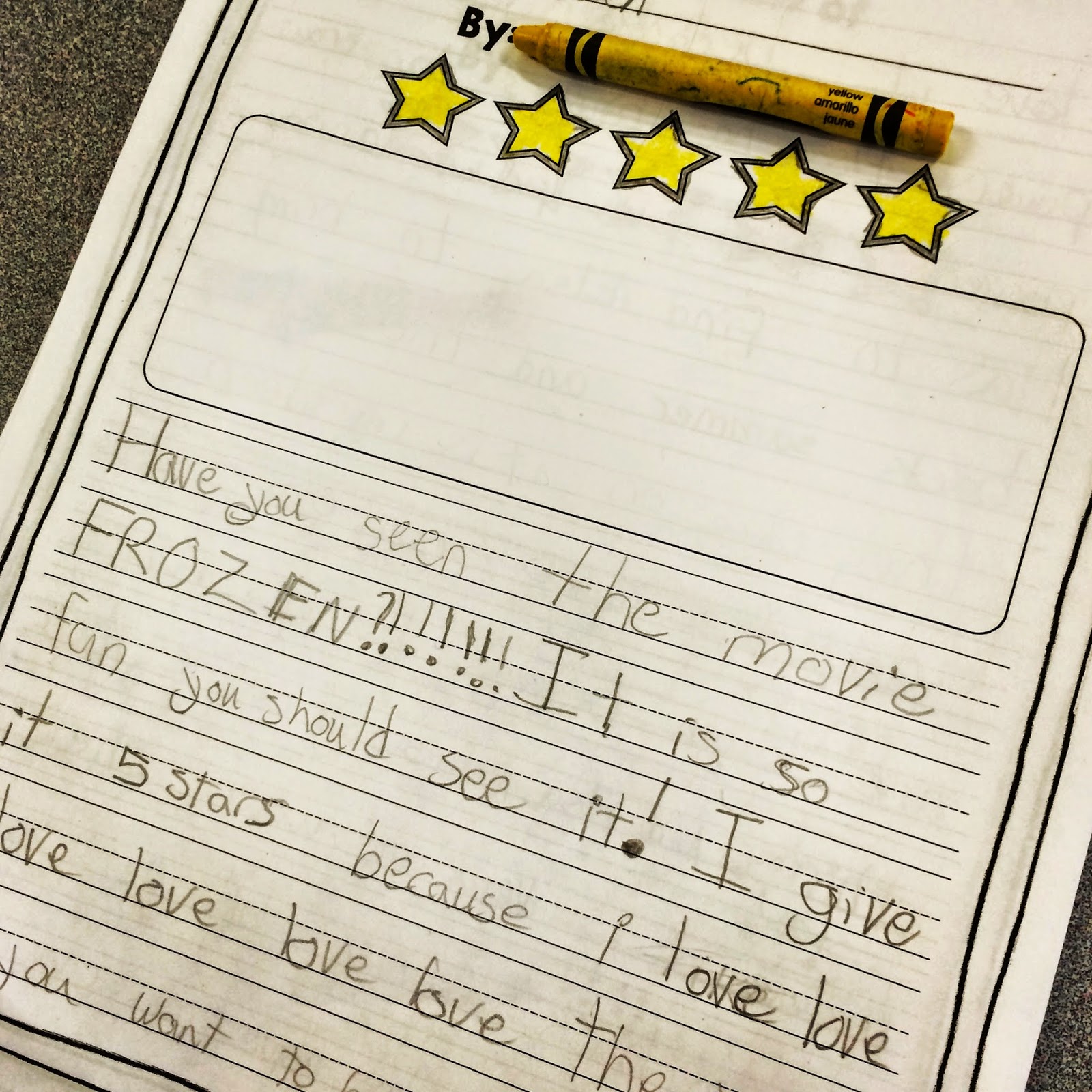
I didn't think to snap that many pictures as we were completing this unit, but here is one of kiddos' paper reviewing the movie, Frozen. He loved it... shocker ;)

This, month long unit, sparked my creativity and I created a detailed opinion writing pack to help you teach your students how to write reviews:

Inside this unit:
- Getting Started: a detailed outline on how I teach the unit
- What is a review? anchor chart
- The parts of a review mini reference posters
- What can we review? anchor chart
- 3 different activities for students to practice reviewing: a toy review, food tasting, and plenty of different review cards
- 2 different 1st grade "exemplar" student samples
- Graphic organizers to map out student thinking
- Writing templates to pick and choose from
- Class book ideas
- Individual and partner editing checklists
- Individual and partner revision checklists
- Writing reviews rubric

A few samples:
A few anchor charts and to help students reference throughout the unit.

Just one of 3 different activities to help students practice reviewing things! There are 3 more sheets of review cards, along with blank ones for you to fill in reviewable items. My kids loved doing these as warm up activities and they can be used for quick writing prompts as well. The other 2 activities are a toy review and a food tasting. I can tell you the students loved all three!

 Some of the "parts of a review" mini reference posters to use throughout the units. I also typed up two different student examples from this year and put them into this unit for reference. They are exemplar pieces, but the students love seeing what they are striving for by the end of this unit.

 Plenty of graphic organizers, paper choices, as well as class book covers to use as you please throughout  this unit.

 Like in all of my writing packs, this one also has editing and revision checklists (individual and partner choices) as well as a rubric at the end to use for assessment purposes!


My kids and I truly loved this little unit and if you like the set up of my other writing packs, I think you will enjoy this as well. Click on the picture above and download the preview to see more of what is offered in the unit. 

As always, Happy Writing!
3

We Love Pigeon! Mo Willems Author Study

We have been learning alllllllll about Mo Willems this week and what author study would be complete without Pigeon?!

We started the author study on Monday learning a little bit about Mo Willems and then throughout the week we read *almost* all of the Pigeon books (Pigeon Needs a Bath is still en route via Scholastic Book Clubs)!

We completed a bunch of activities to help us dig a little deeper into Mo's funnier than funny books. I snapped a few pics:

The kids were pretty darn good at coming up with things Pigeon was thinking in "Don't Let the Pigeon Drive the Bus!"

Then we summarized "Pigeon Wants a Puppy!" ^I just loved this little one's illustrations!

and in "Pigeon Wants a Hot Dog" we thought of some adjectives to describe Pigeon and provided evidence from the text to support our answers.


Today I thought it would be fun to make our cute little pigeon crafts!


Next week we will be diving into Elephant and Piggie and Knuffle Bunny with more fun!

All of the fun we did above is from my Mo Willems Author Study that I uploaded a few weeks ago:

0

Close Reading in 1st Grade - Summer Edition

This teacher has a BIG smile on her face for lots of reasons.

First and foremost, THIS:

Parker and I found out last Tuesday that we were having a BOY!! Our sweet little Theo will be arriving in early October and I literally have not stopped smiling since we found out.
:) :) :)

The second reason I just plain giddy these days is because my students took their end of the year diagnostic tests online and the vast majority of them did AH-MAZING! I am so proud of them. This year I teach in a high poverty, title one school and it was quite the learning curve for me coming from a very affluent, high-performing school in Las Vegas. Many of the skills and standards I taught at the beginning of the year were geared towards early Kindergarten, but these kids have just blown me away with what they were able to accomplish in just 8 short months.

Okay, short bragging session over, but I am sure you other 1st grade teachers can relate to that proud, proud feeling that you get as you see your kiddos get ready for 2nd grade. It is truly remarkable!

Onto what this post was supposed to be about... CLOSE READING! I had been hoping to get my Summer pack out earlier, but just couldn't get around to finishing it/uploading it until last night, so I apologize for the delay. My kids have been working on a few different passages the past two weeks.

For non-fiction we went with parrots:

and for fiction I chose a story that had a "cliff-hanger" ending:

My highest two groups are just pros at this skill by now and I just sat back and snapped a few photos as they read and re-read their passages with their pencils and highlighters in hand:

As always, we went over some vocabulary and used evidence from the text to answer questions about our non-fiction parrots text:

Our fiction story was a little trickier this week as we had to make a big prediction and put our inferencing skills to the test:

While we probably won't complete ALL of the stories in this summer-themed pack, I will be sending home quite a few of them for the summer! The kids are well-trained in how to respond to the questions, so I am hoping a little practice with these skills over the summer will keep them sharp!

I put the summer pack on sale through Tuesday (5/13) in case you would like to grab it!

Nonfiction texts included:
- Parrots
- Dolphins
- The Sun
- Ice Cream
- Independence Day

Fiction texts included:
The Sandcastle Contest - a story about a boy who enters a sandcastle contest and eagerly awaits the announcement of who wins
Look What I Caught! - a story about a boy who finds a big, red crab at the beach and doesn't understand why his mom and sisters aren't as excited as he is
Learning to Swim - a story about a boy who gets scared in the middle of his swim lessons and makes him mom very proud
My Summer Vacation - a story about a girl who overcomes her fear of flying to vacation in Hawaii
Pool Party - a story about a girl who is about to throw a big pool party when all of a sudden a storm threatens to ruin it

For those of you who have tried my close reading passages, I hope you and your students have enjoyed them! My students have shown so much growth and I hope yours have too!

If you want to try the winter or spring ones you can see them here:


3
Back to Top